What is Play Therapy?
Although sometimes used with adults, play therapy is a psychotherapeutic approach primarily used to help children ages 3 to 12 explore their lives and freely express repressed thoughts and emotions through play. Therapeutic play normally takes place in a safe, comfortable playroom, where very few rules or limits are imposed on the child, encouraging free expression and allowing the therapist to observe the child’s choices, decisions, and play style.
When is Play Therapy used?
Therapeutic play helps children with social or emotional deficits learn to communicate better, change their behavior, develop problem-solving skills, and relate to others in positive ways. It is appropriate for children undergoing or witnessing stressful events in their lives. Play therapy can help children with academic and social problems, learning disabilities, behavioral disorders, anxiety, depression, grief, or anger, as well as those with attention deficit disorders or who are on the autism spectrum.
What to expect in Play Therapy
The parent or caregiver plays an important role in play therapy for children. After conducting an initial intake interview with the parent, and often a separate interview with the child, the therapist can make an assessment prior to beginning treatment. In the playroom, the child is encouraged to play with very specific types of toys that encourage self-expression and facilitate the learning of positive behaviors.
What type of play?
Arts and crafts, music, dancing, storytelling, and other tools may also be incorporated into play therapy.
How Play Therapy works
Play therapy responds to the unique developmental needs of young children, who often express themselves better through play activities than through verbal communication. The therapist uses play and other creative activities to communicate with the child and observe how the child uses these activities to express thoughts and feelings that are not expressed in words.
Approaches to Play Therapy
- Nondirective play therapy is based on the principle that children can resolve their own issues given the right conditions and the freedom to play with limited instruction and supervision.
- Directive play therapy uses more input from the therapist to help speed up results. Play therapists use both approaches, depending on the circumstances.
Benefits of Play Therapy
Play therapy helps children:
- Become more responsible for behaviors and develop more successful strategies.
- Develop new and creative solutions to problems.
- Develop respect and acceptance of self and others.
- Learn to experience and express emotion.
- Cultivate empathy and respect for thoughts and feelings of others.
- Learn new social skills and relational skills with family.
- Develop self-efficacy and thus a better assuredness about their abilities.
How long does Play Therapy take?
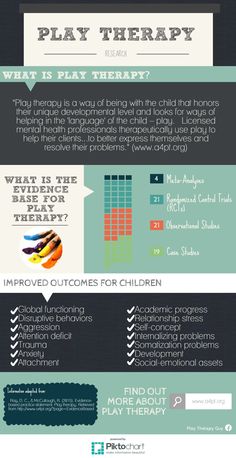
Each play therapy session varies in length but usually lasts about 30 to 50 minutes. Sessions are usually held weekly. Research suggests that it takes an average of 20 play therapy sessions to resolve the problems of the typical child referred for treatment. Some children may improve much faster, while more serious or ongoing problems may take longer to resolve.
Can family be involved in Play Therapy?
The play therapist will make some decisions about how and when to involve some or all members of the family in the play therapy.
Why Play in Therapy
The goal is to help children learn to express themselves in healthier ways, become more respectful and empathetic, and discover new and more positive ways to solve problems.
Play therapy is a structured, theoretically based approach to therapy that builds on the normal communicative and learning processes of children. Therapists strategically utilize play therapy to help children express what is troubling them when they do not have the verbal language to express their thoughts and feelings. Through play, therapists may help children learn more adaptive behaviors when there are emotional or social skills deficits.
Play therapy may also be used to promote cognitive development and provide insight about and resolution of inner conflicts or dysfunctional thinking in the child.
Call us at 469-714-0006 or email us at info@exulthealthcare.com
Scientific Backing of Play Therapy
Is Play Therapy A Real Thing And Does It Really Work?
Understanding play therapy and the science behind adolescent play.
Learn MoreChild’s Play: How Play Therapy Works
An article delving into how children comprehend play therapy.
Learn MoreKey Benefits of Therapy at Exult
Children are going through high-stress times. At Exult, we have multiple professionals who are licensed in helping your child.
- Group therapy
- Individual therapy
- Access to on-site psychiatrist
- Providers work together
- Tailored program for your loved one
- Afternoon hours
- Yoga and Mindfulness
FAQs
Will insurance cover it?
Our Accepted Health Insurances
Please call our office or your insurance provider for more details.
What mood disorders are taken?
Disorders include but are not limited to: Depression, ADHD, PTSD, trauma, Bipolar Disorder, self-harm, OCD, anxiety, Schizophrenia, and other mood disorders.
Come in for a screening to determine if this is the right route for you.
Are medications prescribed?
We offer medication management but we try to keep an open discussion between the client, therapist, and psychiatrist as to the needs of the client.
Schedule an Appointment
Ready to take the first step toward better mental health?
Get StartedCall: (469) 714-0006
Our Locations
McKinney
4801 Medical Center Dr
McKinney, TX 75069
Sherman
600 E Taylor St
Sherman, TX 75090